


How To Tell The Age Of A Cockatiel: A Complete Guide For Bird Owners
I brought home a rehomed cockatiel with zero paperwork and my first thought was straightforward: how old is this bird? That question shapes everything from diet to vet schedules to whether taming is realistic on a short timeline. This guide walks you through how to tell the age of a cockatiel using eye color, feather patterns, crest growth, and behavioral cues so you can build a reliable age estimate at home without guessing.

Key Takeaways
- Dark irises that lighten over the first year are among the most accessible cockatiel age indicators, but only work reliably in normal grey mutations
- Juvenile tail barring disappears after the first molt, typically between six and twelve months
- Cross-referencing at least three physical and behavioral signs produces a far more accurate estimate than any single indicator alone
- Senior cockatiels past ten years show distinct physical slowdowns that require adjusted care routines
- An avian veterinarian remains the most reliable source for age confirmation when home assessment gives conflicting results
Table of Contents
How To Tell The Age Of A Cockatiel
Age drives nearly every care decision you will make for your bird. A cockatiel under six months needs different handling, socialization, and nutrition than one that is five years old or approaching senior status. Getting the age wrong means getting the care wrong.
The honest reality is that physical age estimation gives you a range, not a birthday. Methods here are most reliable during the first twelve months when developmental changes are still visible. After a cockatiel passes two years, distinguishing between a three-year-old and a six-year-old becomes difficult without veterinary help.
My approach is to layer multiple indicators together. Each confirmed sign narrows the range. Think of it as a checklist where three or more aligned answers move you from a guess to a working conclusion.
What Are The Visual Signs That Indicate A Cockatiel’s Age?
A head-to-tail visual assessment is your starting point. You are looking at the eyes, feather markings across the body and tail, and the crest. Each feature changes in predictable ways as a cockatiel develops from hatchling to adult.
One practical detail that makes a real difference: always assess in natural daylight. I learned this the hard way when I misjudged a bird’s iris color under a warm-toned lamp and underestimated its age by several months. Artificial lighting distorts iris tone and makes feather barring harder to read accurately.
Is Your Cockatiel Younger Than You Think?
Dark irises and tail barring disappear fast — miss these early signs and you could misjudge your bird’s age by months, throwing off its entire care routine.
How Does Eye Color Reveal A Cockatiel’s Age?
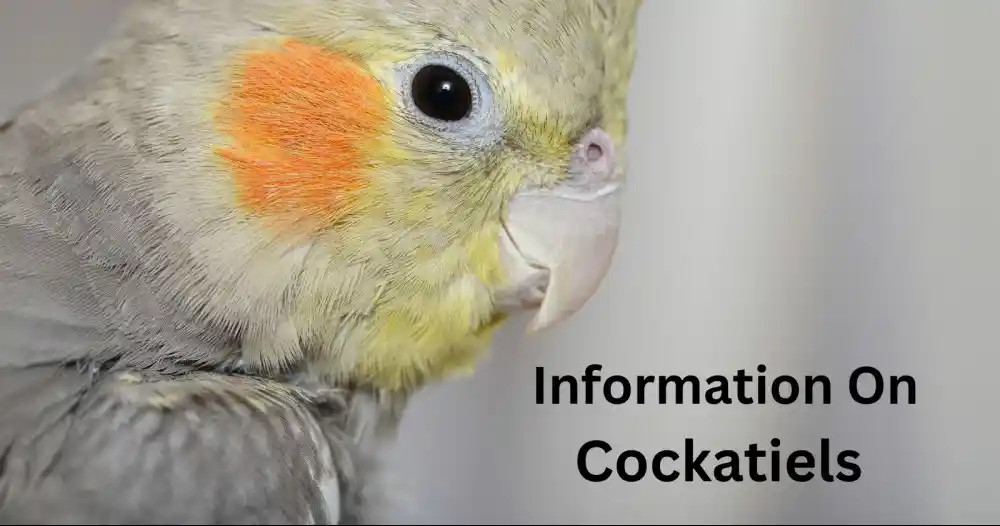
Young cockatiels hatch with dark brown to near-black irises. As the bird develops, the iris gradually lightens toward a warmer reddish-brown tone. This shift usually becomes noticeable between six and eight months of age.
By 12 to 18 months, most normal grey cockatiels have reached their adult eye color. The rate varies between individuals and is best assessed in natural daylight where the true iris tone is visible. Artificial lighting frequently makes a transitioning iris appear darker than it actually is, which leads to underestimating age.
Critical caveat: this does not work for lutino or albino cockatiels. Both carry a genetic absence of melanin that produces red eyes at every life stage. If you own one of these mutations, skip eye color entirely and rely on feather barring and crest development instead.
What Does Feather Coloration Tell You About A Cockatiel’s Age?
Before their first molt, juvenile cockatiels display horizontal barring on the underside of the tail feathers. This barring appears as alternating light and dark bands and is one of the clearest juvenile markers available. Facial coloring at this stage is muted with pale yellow markings and less defined cheek patches.
The first molt is the turning point. It typically begins between six and twelve months, with timing influenced by diet quality, stress levels, and genetics. During active molt, look for pin feathers, those small sheath-covered emerging feathers around the head and nape. Multiple active pin feathers confirm molt is currently in progress rather than already complete. This is a detail you will only notice by looking closely at the bird in person.
After the first molt, adult plumage takes over. Male normal grey cockatiels show a bright yellow face and vivid orange cheek patches with no tail barring. Females typically retain some barring and paler facial color. A dull coat in a bird past its first molt may indicate poor nutrition rather than advanced age, so always consider health as a variable.
How Does Crest Development Help Identify A Cockatiel’s Age?
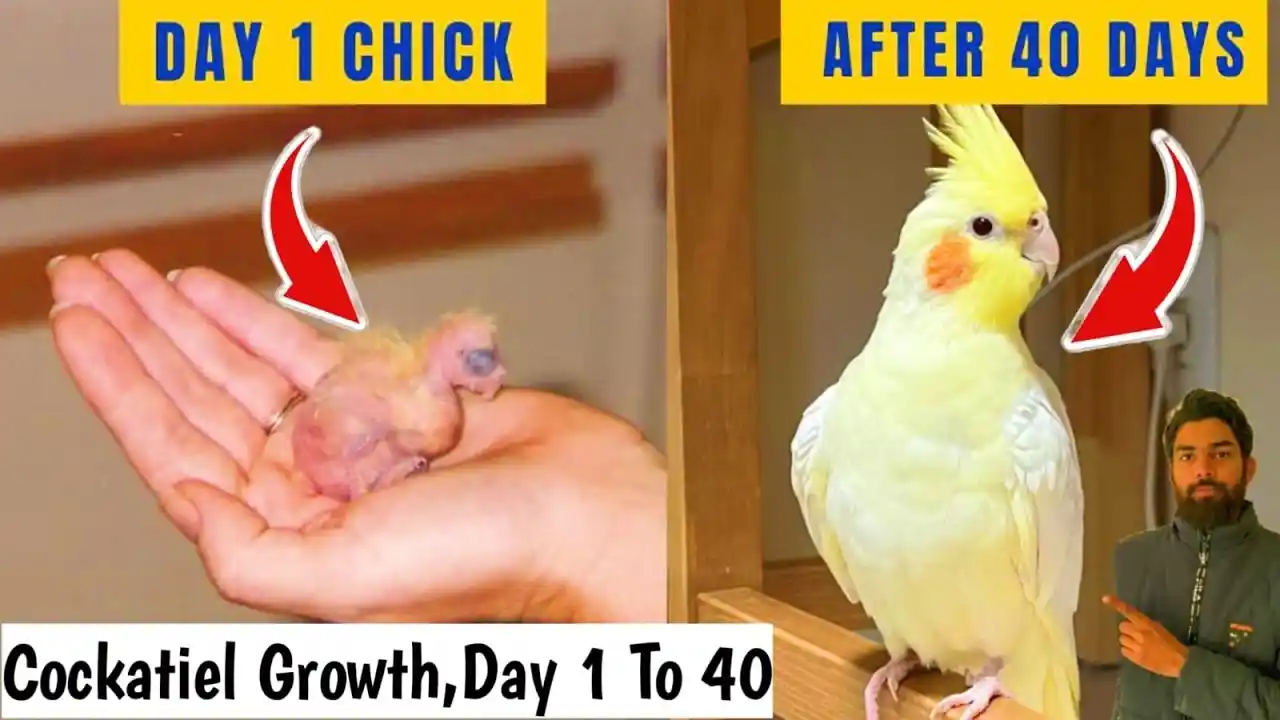
Newly hatched cockatiels have barely any visible crest. Over the first several weeks of life, it grows progressively longer and more defined.
By adulthood, the crest becomes the bird’s primary emotional communication tool. A mature cockatiel modulates its crest through a full range of positions: raised when alert, mid-position when relaxed, flattened when defensive. Young birds show more reflexive, less controlled crest movement. If your bird adjusts its crest expressively during normal interaction, responding to subtle environmental cues rather than only strong stimuli, it is almost certainly past the juvenile phase.
When Is A Cockatiel Fully Grown?
Cockatiels move through five broadly recognized developmental stages. Understanding where each stage begins and ends helps you place a bird within an age bracket even without documentation.
| Developmental Stage | Approximate Age | Key Marker |
|---|---|---|
| Hatchling | 0 to 4 weeks | Eyes closed, fully dependent |
| Fledgling | 4 to 10 weeks | Learning to fly, beginning weaning |
| Juvenile | 3 to 6 months | Barred tail feathers, dark irises |
| Sub-adult | 6 to 12 months | First molt underway, iris lightening |
| Adult | 12 months onward | Full adult plumage, stable behavior |
Full physical maturity generally arrives around 12 months. Sexual maturity often appears earlier, between six and twelve months, meaning a young cockatiel may display breeding behaviors before it is physically ready. Behavioral maturity, including stable temperament and complex vocalizations, typically solidifies between 12 and 18 months.
How Do Behavior Patterns Help Determine A Cockatiel’s Age?
Physical signs tell you what the bird looks like. Behavioral signs tell you how it acts. These two types of evidence are complementary, not competing, and combining them produces your most reliable age estimate.
Young cockatiels are noticeably erratic. They explore compulsively, startle easily, and vocalize with simple repetitive calls. Biting at this stage often reflects curiosity rather than aggression.
So what does this look like in practice? A bird that whistles a recognizable tune, returns to a preferred perch consistently, and responds to your voice with varied contextual sounds is almost certainly past twelve months. A bird that scrambles constantly and calls in simple repeated tones is more likely in the juvenile to sub-adult range.
Senior cockatiels past ten years tend to sleep more, play less, and vocalize with decreasing frequency. These changes are gradual. A sudden shift at any age warrants veterinary attention from a certified practitioner. The Association of Avian Veterinarians maintains a directory that helps you locate a qualified avian vet in your area.
How Old Is My Cockatiel And How Can I Estimate Its Age At Home?
Working through a structured self-assessment produces a far more reliable result than a single observation. Here is the process I recommend:
- Examine the eyes in natural daylight. Dark irises point toward juvenile status. Warm brown irises suggest past six to eight months.
- Check the tail underside for barring. Present means juvenile or sub-adult. Absent in a male strongly suggests post-molt adult.
- Assess facial markings. Pale, undefined cheek patches suggest juvenile. Vivid, clearly bordered patches suggest adult.
- Observe the crest over several minutes. Reflexive movement suggests juvenile. Varied context-appropriate positioning suggests adult.
- Watch behavior across multiple sessions. Erratic exploration and simple calls suggest under twelve months. Stable routine and complex sounds suggest adult or older.
Cross-reference at least three indicators. If two suggest juvenile and two suggest adult, the bird is most likely in the sub-adult transitional phase between six and twelve months.
Branching Quiz: How Old Is Your Cockatiel?
Use this decision path to narrow your bird’s age range.
Step 1: Are your cockatiel’s irises dark brown or black?
- Yes – move to Step 2.
- No, they are warm brown or reddish-brown – move to Step 3.
- They are red (lutino or albino) – skip to Step 2 and note that eye color is not a reliable indicator for your mutation.
Step 2: Do you see horizontal barring on the underside of the tail feathers?
- Yes – your bird is likely under 6 months old (juvenile phase).
- No barring visible – move to Step 3.
Step 3: Does your bird whistle recognizable tunes or mimic household sounds?
- Yes – your bird is likely 12 months or older (adult phase).
- No, vocalizations are simple and repetitive – your bird is likely 6 to 12 months old (sub-adult phase).
Step 4: Does your bird sleep noticeably more during the day and show reduced interest in play?
- Yes, and past sub-adult stage – your bird may be 10 years or older (senior phase).
- No – your bird is likely in the 1 to 10 year adult range.
This quiz provides an estimate only. For professional confirmation, consult a certified avian veterinarian.


What Do Cockatiel Age Pictures Show About Bird Development?
Side-by-side reference photos give you a benchmark for direct visual comparison with your own bird. When reviewing photos, examine features in this order of reliability:
- Tail feather underside: barring visible or absent
- Eye color and iris tone under similar lighting conditions
- Facial marking definition and cheek patch vibrancy
- Crest length relative to the head
Prioritize sources connected to verified breeders or avian veterinary practices rather than unverified social media posts. The Lafeber Company cockatiel resource provides reliable photographic references alongside veterinary-reviewed care guidance.
How Does A Bird Age Calculator Work For Cockatiels?
A bird age calculator converts a known cockatiel age into an estimated human developmental equivalent using species average lifespan data.
The critical limitation: a calculator requires a known age as input. If you do not know your bird’s age, the calculator cannot determine it. Use physical observation first to establish a working estimate, then apply a calculator to understand what life stage that estimate represents. Using a calculator before completing a physical assessment produces no useful result.
What Is A Cockatiel’s Age In Human Years?
This conversion is a metaphorical comparison tool, not a biological equivalence. It should never drive medical or dietary decisions on its own. Those decisions belong with an avian veterinarian assessing the individual bird.
| Cockatiel Age | Human Equivalent | Life Stage | Care Priority |
|---|---|---|---|
| 0 to 6 months | Infancy to childhood | Juvenile | Socialization, weaning support |
| 6 to 12 months | Adolescence | Sub-adult | First molt support, training |
| 1 to 5 years | Young adult | Mature adult | Balanced nutrition, enrichment |
| 5 to 10 years | Middle age | Prime adult | Preventive vet checkups |
| 10 years onward | Senior | Aging | Lower perches, softer foods |
This table is for orientation purposes only. Consult an avian vet for age-specific health guidance.
Age Your Cockatiel the Way Avian Vets Do
Cross-reference eye color, feather barring, and crest development using the same multi-indicator method trusted by avian veterinary professionals worldwide.
What Are The Signs Of An Old Cockatiel?
Feathers may grow back more slowly after molt, appear thinner, or show reduced vibrancy. The crest may rest lower during periods of rest. Some older birds develop a slightly rounded perching posture, and beak and nail growth can become irregular.
Behaviorally, senior cockatiels sleep more, explore less, and vocalize with decreasing regularity. The depth of their bond with familiar people often increases even as physical activity decreases.
Adjusting care is practical and manageable. Lower perches reduce fall risk. Softer food options help if beak strength diminishes. Veterinary checkups should increase to every six months past ten years. The Cornell Lab of Ornithology provides species-level reference data useful for monitoring age-related health changes.
How Is Cockatiel Sexing Related To Age Identification?
Sex determination and age identification are closely linked because the most reliable visual sex markers only appear after the first molt. Before that point, males and females of most mutations look identical without DNA testing.
Once adult plumage develops between six and twelve months, male normal grey cockatiels display bright yellow faces and vivid cheek patches with no tail barring. Females retain paler coloring and may keep some barring. Confirming these markers tells you two things at once: the bird’s sex and the fact that it has passed the juvenile phase.
For mutations where visual sexing remains unreliable at any age, DNA sexing is the most accurate method available.
| Mutation | Eye Color Reliable? | Feather Barring Reliable? | Best Alternative |
|---|---|---|---|
| Normal grey | Yes | Yes | N/A |
| Lutino | No | Partially | DNA sexing |
| Albino | No | Partially | DNA sexing |
| Pied | Yes | Variable | Combine indicators |
| Pearl | Yes | Yes | Post-molt pattern |
How Does Telling A Cockatiel’s Age Compare To Telling A Budgie’s Age?
Both species show early eye color changes and undergo a first molt that transitions juvenile plumage to adult coloring. Beyond those shared principles, the methods diverge in important ways.
Budgies display bar markings on the forehead and cap during the juvenile phase rather than the tail underside. Their first molt occurs earlier, around three to four months compared to six to twelve months in cockatiels. Applying budgie aging logic directly to a cockatiel will produce an inaccurate result because the indicator locations and developmental timelines differ significantly.
| Indicator | Cockatiel | Budgie |
|---|---|---|
| Juvenile barring location | Tail underside | Forehead and cap |
| Eye color change | Dark to warm brown | Dark to pale iris |
| First molt timing | 6 to 12 months | 3 to 4 months |
| Full maturity | Around 12 months | Around 6 months |
Download the Complete Cockatiel Age Checklist
Every physical and behavioral indicator in one printable reference — eye color stages, molt timing, senior signs, and mutation-specific exceptions included.
Frequently Asked Questions About How To Tell The Age Of A Cockatiel
How To Tell The Age Of A Cockatiel Using Physical Features Alone?
Examine three features in natural daylight: eye color, tail feather barring, and crest development. Dark irises combined with visible tail barring and a small crest suggest under six months. Warm brown irises, absent barring in a male, and a full expressive crest suggest past twelve months. Always cross-reference all three and account for your bird’s specific mutation since some indicators are unreliable for lutino and albino birds.
What Behavioral Signs Help Identify How Old A Cockatiel Is?
Young cockatiels are erratic and vocal with simple repeated sounds. Adults show predictable routines, stronger bonding, and complex vocalizations including whistling and mimicry. Senior birds vocalize and play less while sleeping more throughout the day. Behavioral cues are most valuable when physical markers are ambiguous or when your mutation limits the reliability of visual indicators.
Does A Cockatiel’s Age Affect How Easy It Is To Tame?
Age influences tamability but does not determine it. Young well-socialized cockatiels generally tame faster. Older rehomed birds may need more time to build trust, especially with limited prior positive human contact. I have worked with rehomed cockatiels past five years old that became fully handleable within two months of daily low-pressure sessions. With consistent patient interaction, birds at many ages form strong bonds. The process simply takes longer and requires gentler handling with older or previously unsocialized birds.