All Wings Aviary



How Long Do Cockatiel Eggs Take To Hatch: Sitting And Hatch Signs
You watch the nest box, checking for movement, wondering if the chicks are okay. It is normal to feel anxious. The standard incubation period for cockatiel eggs is typically 18 to 21 days. This countdown usually begins after the second or third egg is laid, as parents often start serious sitting then. This guide breaks down exactly what to expect, how to check if the eggs are viable, and what to do if day 21 passes without a peep.

Key Takeaways
- Cockatiel eggs generally hatch between 18 and 21 days after incubation starts.
- Both parents share the job of sitting on the eggs.
- Temperature fluctuations are the main reason for delayed hatching.
- Candling is the safest way to check for fertility without harming the embryo.
- Never assist a chick in hatching unless you are experienced, as it can cause fatal bleeding.
- A float test can verify if an egg is alive but risks damaging the egg if done incorrectly.
- Chicks need specific humidity levels to pip successfully.
- Abandonment for more than a few hours can kill the embryo.
- Hens can lay eggs without a male, but they will be infertile.
- Post-hatch care is critical for the first 48 hours of the chick’s life.
Table of Contents
How Long Do Cockatiel Eggs Take To Hatch
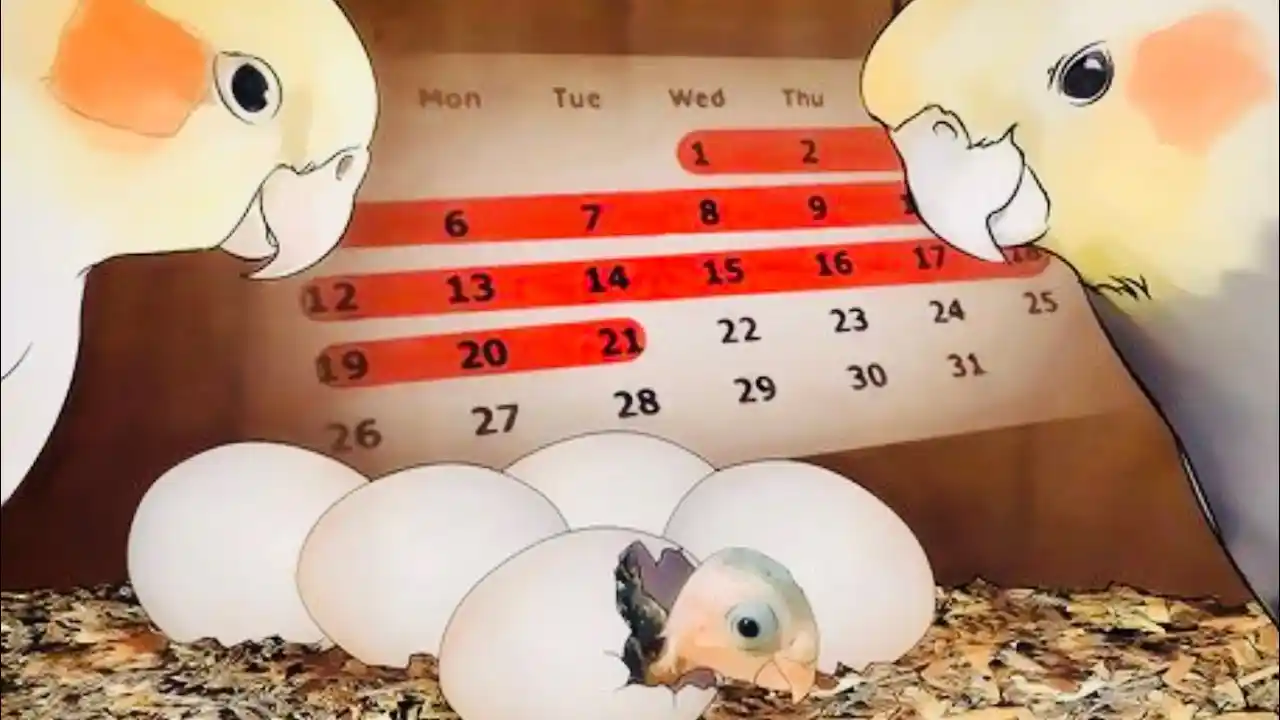
The direct answer is 18 to 21 days. This is the standard window for cockatiel eggs to hatch once the parents begin full incubation. Full incubation means the eggs are kept at a constant warm temperature nearly 24 hours a day.
But do not set your calendar in stone just yet. Several factors can stretch or shrink this window. If your home is on the cooler side, the metabolic rate of the embryo slows down. This can push hatching to day 22 or even day 23. Conversely, a very warm environment might speed things up slightly.
Consistency is the secret sauce. A healthy pair will switch off duties like a relay team. The female usually sits overnight. The male takes the day shift. If this rhythm breaks, the timer gets messy. If the eggs are left cold for long stretches, development pauses. It does not die immediately, but it stops growing. When warmth returns, it resumes. This stop-start pattern is the most common reason eggs hatch late.
How Long Does A Bird Egg Take To Hatch Compared To A Cockatiel Egg?
Context helps you understand why cockatiels sit in the middle of the bird parenting spectrum. Smaller birds have faster metabolisms. Larger birds have longer developmental cycles.
Table 1: Incubation Periods of Common Pet Birds
| Bird Species | Average Incubation (Days) | Primary Parent Sitting |
|---|---|---|
| Budgerigar | 18 | Female |
| Cockatiel | 18 – 21 | Both (Female night) |
| Lovebird | 23 | Female |
| African Grey | 28 | Female |
| Macaw | 26 – 28 | Female |
Cockatiels are unique because the male plays a massive role. In many parrot species, the female does almost all the work. For cockatiels, the male is an active partner. This dual-parent system actually helps keep the timeline consistent. If one parent struggles, the other covers.
Environmental factors hit all birds the same way. Humidity is the silent killer here. If the air is too dry, the membrane inside the egg gets tough. The chick cannot pip through. It gets trapped and dies. If it is too humid, the chick might drown in fluid or develop bacterial infections. Cockatiels originate from arid regions of Australia, but captive breeding demands stable conditions to mimic the safety of a tree hollow.
Are Your Cockatiel Eggs Still Alive After Day 21?
Most owners panic when eggs don’t hatch on schedule. Discover exactly how to candle, test, and save a delayed clutch before it’s too late.
How Long Does A Cockatiel Sit On Her Eggs Before They Hatch?
A healthy cockatiel pair will sit on the eggs almost continuously. You should rarely see the nest box empty during the 18 to 21 day period. The female typically takes the night shift, staying on the eggs from dusk until dawn. The male relieves her in the morning so she can eat, drink, and stretch.
During the day, they swap multiple times. You might hear them communicating softly at the nest box entrance. This is the changing of the guard.
What does abnormal sitting look like?
- Both parents outside: If both birds are hanging out on the play gym for hours, the eggs are cooling down.
- Broken eggs in the nest: This signals distress or inexperience.
- Aggression: If the female attacks the male when he tries to approach, she is stressed or the eggs are not viable.
If you notice the nest is unattended for more than an hour or two, check the temperature. If it is cold, the parents might have abandoned them. How To Incubate Cockatiel Eggs At Home
Sometimes you have to step in. Maybe the parents abandoned the clutch. Maybe they are young and smashing the eggs. Artificial incubation is difficult but rewarding.
To succeed, you need three variables perfect: Temperature, Humidity, and Turning.
- Temperature: Set your incubator to 37.2°C (99°F). Even a 1-degree variance can ruin the hatch.
- Humidity: Aim for 50-55% relative humidity for the first 18 days. Raise it to 65% for the final days (lockdown).
- Turning: Eggs must be turned at least 3-5 times a day to prevent the embryo from sticking to the shell.
If you are looking for a reliable egg incubator for your cockatiels, explore our range of incubators and brooders designed specifically for small parrots. Shop now and give your eggs the best chance of hatching successfully.
What Equipment Do You Need To Incubate Cockatiel Eggs?
You cannot just put an egg under a heat lamp. Well, you can, but it usually ends badly. You need specific tools to mimic the mother bird.
Table 2: Essential Incubation Equipment Checklist
| Equipment | Purpose | Why It Matters |
|---|---|---|
| Incubator | Housing & Heating | Maintains constant 99°F |
| Hygrometer | Humidity Reading | Prevents chick drowning/sticking |
| Thermometer | Temperature Check | Avoids cooking or freezing embryo |
| Candling Light | Viability Check | Removes dead eggs early |
| Egg Turner | Automatic Rotation | Mimics natural parent movement |
Setup is critical. Run your incubator for 24 hours before putting eggs in. Verify the temperature with a separate thermometer. Trusting the built-in dial is a rookie mistake. They are often off by several degrees. Calibrating your equipment ensures you do not cook your chicks before they start growing.
How To Tell If A Cockatiel Egg Is Going To Hatch
You cannot see through the shell, so you have to use light. Candling is the process of shining a bright beam through the egg to reveal the interior. It sounds complex, but it is actually quite simple.
Do not candle every day. It disturbs the embryo. Candle around day 5 or 6.
Table 3: Cockatiel Embryo Development Timeline
| Day | Visual Sign When Candling | What To Do |
|---|---|---|
| 5 | Red spider veins appear, small dark spot | Confirm fertility |
| 7 | Dark spot grows larger, veins spread | Continue turning |
| 12 | Egg is mostly dark, air cell visible | Stop turning soon |
| 18 | Full dark mass, egg rocks | Increase humidity (Lockdown) |
Branching Quiz: Should You Assist the Hatch?
Is the egg piping (a hole in the shell)?
- Yes: Has the hole been there for more than 24 hours with no progress?
- Yes: Consider very gentle assistance.
- No: Do nothing. Put it back.
- No: Can you hear chirping inside?
- Yes: Wait. It is in the internal pip stage.
- No: Candle the egg. Is it moving?
- Yes: Wait. It is not ready.
- No: It may have died.
Do Dead Cockatiel Eggs Sink Or Float In Water?
This is the float test. It is controversial. To do it, you gently place the egg in a bowl of lukewarm water.
- Floating: The egg is alive. The chick is moving or the air cell is large enough to buoy it.
- Sinking: The egg is likely dead or infertile. It is dense.
- Bobbing: If it sinks but stands on its end, it is borderline.
Warning: Use this as a last resort only. Water introduces bacteria to the porous shell. If the water is too cold, it can shock the chick. If you must do it, dry the egg immediately and warm it gently. Many breeders skip this entirely because the risk of harm outweighs the curiosity.
What Happens If Cockatiel Eggs Are Not Hatching After 21 Days?
Do not panic. The 21-day mark is an average, not a deadline.
If day 21 passes:
- Candle the egg: Is there movement? Is the air cell huge? If the chick is alive, give it 2 more days.
- Check humidity: If the membrane is dry, the chick might be shrink-wrapped and unable to move. Increase humidity to 70%.
- Listen: Tap the egg gently with your fingernail. A live chick often taps back or cheeps.
Causes for failure:
- Infertility: The male was not fertile.
- Temperature crashes: The embryo died early from cold.
- Malposition: The chick positioned its head wrong and could not pip.
- Genetic defects: Fatal deformities.
If you candle and see no movement, and the egg is cold to the touch inside the incubator, it is likely over. But if there is any doubt, wait until day 24 before discarding. Better safe than sorry.


How Long Can A Bird Egg Survive Without The Mother Sitting On It?
This is the scary part for owners who see the nest empty. Bird eggs are surprisingly resilient for short periods. They can survive cooling down. In fact, in nature, hens leave to eat.
However, there is a limit. If the temperature drops below physiological zero (around 80°F or 26°C), development stops. If it stays there for a few hours, the embryo can usually recover. But if the eggs get cold (room temperature of 70°F) for 4-6 hours, the risk of mortality spikes.
If you find abandoned eggs:
- Warm them up immediately.
- Put them in an incubator or under a heat lamp (carefully).
- Watch the parents. Are they sick? Are they fighting?
- If the parents refuse to return after you warm the eggs, you must incubate artificially or the eggs will die within a day.
A hen abandoning eggs due to a nearby construction noise disturbance
When Do Cockatiels Start Laying Eggs?
Female cockatiels reach sexual maturity around 6 to 12 months of age. However, just because they can lay eggs does not mean they should. Breeding too young drains their calcium and can kill them.
Triggers for laying:
- Light: Long days (12+ hours of light) simulate spring/summer.
- Nesting: A dark cavity or box triggers the instinct.
- Diet: A soft, rich diet signals abundance.
- Mate: The presence of a male (or even a mirror) can stimulate ovulation.
Chronic egg laying is a serious health risk. It depletes calcium, leading to egg binding (where the egg gets stuck). If your hen lays more than 2 clutches a year without a mate, consult a vet to suppress the cycle.
What Are The Basics Of Cockatiel Breeding And Nesting Requirements?
Breeding is not just putting two birds in a cage. You need a setup that mimics their natural environment to reduce stress.
Table 4: Breeding Setup Requirements
| Requirement | Specification | Reason |
|---|---|---|
| Cage Size | Minimum 24″x24″x36″ | Space for flight and wing exercise |
| Nest Box | 12″x12″x12″ vertical | Mimics tree hollows |
| Bedding | Unscented pine shavings | Absorbs droppings, prevents slipping |
| Diet | Calcium block + soft food | Supports egg formation and chick growth |
Prepare the environment before introducing the pair. Ensure they are on a high-calcium diet weeks before breeding. Cuttlebone is essential. Once they bond, they will explore the box. Do not disturb them constantly. Privacy is key to successful mating and incubation.
Browse our complete cockatiel breeding starter kits. Everything you need to set up a safe and successful nesting environment is available online with fast delivery.
How Expert Breeders Hatch Every Cockatiel Egg Successfully
Experienced breeders maintain 99°F precision and 50–65% humidity through every stage. Get the same professional incubation setup trusted by cockatiel specialists.
What Does The Cockatiel Egg Hatching Process Look Like?
Hatching is a marathon, not a sprint. It takes hours.
- Internal Pip: The chick breaks into the air cell inside the egg. It takes its first breath. You might hear cheeping.
- External Pip: The chick makes a small hole in the shell. This is called pipping.
- Unzipping: The chick rotates inside the egg, cracking the shell in a circle.
- Emergence: The shell splits, and the wet chick pushes out.
The egg tooth is a small sharp point on the beak used to crack the shell. It falls off a few days after hatching.
Crucial advice: Do not help. If you peel the shell too early, the blood vessels might still be attached. You can bleed the chick to death. Only intervene if the chick has been pipped for 24+ hours with no progress.
What Do Fertilised Cockatiel Eggs Look Like And How Do You Identify Them?
At the moment of laying, a fertilized egg looks identical to an infertile one. It is white or slightly off-white. Do not judge by the shell texture or color.
You must wait 5-7 days to candle.
- Infertile: Clear, glowing bright yellow.
- Fertile: Dark shadow, red veins.
- Blood Ring: A red circle inside the egg indicates the embryo died early.
Wait until day 7 to be sure. Candling too early can mistake a slow-starting fertile egg for an infertile one.
How Should You Care For Cockatiel Hatchlings After The Eggs Hatch?
The first 24 hours are critical. The chick absorbs the yolk sac before hatching, so it does not need food immediately. It needs warmth.
- Temperature: 95°F (35°C) for the first week.
- Feeding: If the parents feed it, leave them alone. If you are hand-rearing, feed every 2 hours around the clock.
Crop issues are common. The crop is the sack at the base of the neck. It should empty between feeds. If it stays full, the chick has sour crop or impaction. This requires immediate veterinary attention. The transition to weaning happens around 8-10 weeks.
What Real Owners Have Learned From Hatching Cockatiel Eggs At Home
The cockatiel community is vast. Experienced breeders share one common lesson: Expect failure before success.
- The Dud Clutch: Most first-time pairs fail. They crush eggs or abandon them. It is heartbreaking but normal.
- The Noise: Chicks are loud. They cheep constantly for food.
- The Mess: Nest boxes get filthy fast. You must change bedding regularly without disturbing the hen too much.
Connect with local bird clubs. They are invaluable resources. They can help you sex your birds, vet check your pairs, and source incubators. Do not go it alone.
Download the Complete Cockatiel Incubation Checklist
From temperature calibration to lockdown humidity, get the full 18–21 day incubation checklist — every tool, every milestone, every warning sign in one place.
Frequently Asked Questions About How Long Do Cockatiel Eggs Take To Hatch
How Long Do Cockatiel Eggs Take To Hatch And What Should I Expect?
Expect a wait of 18 to 21 days. You should expect the parents to be protective and slightly aggressive. You should also expect that not every egg will hatch. A typical clutch is 4 to 6 eggs, but often only 3 or 4 hatch successfully.
How Do I Know If My Cockatiel Egg Is Going To Hatch?
The best sign is candling. Look for a dark mass filling the egg and a large air cell at the end. In the final days, you might see the egg wobble slightly as the chick turns inside. You will also hear faint tapping or peeping sounds coming from inside the shell.