


Dracula Parrot for Sale: What Buyers Actually Need to Know About Legality, Cost, and Care
If you have been searching for a Dracula parrot for sale, the answer is not what most listings claim. Pesquet’s parrots (also called Dracula or vulturine parrots) are not legally available to private buyers in the United States or many other countries. Their vulnerable conservation status, strict CITES protections, and highly specialized fig-based diet make private ownership both illegal in most cases and impractical for even the most experienced bird keepers.
What Is a Dracula Parrot?
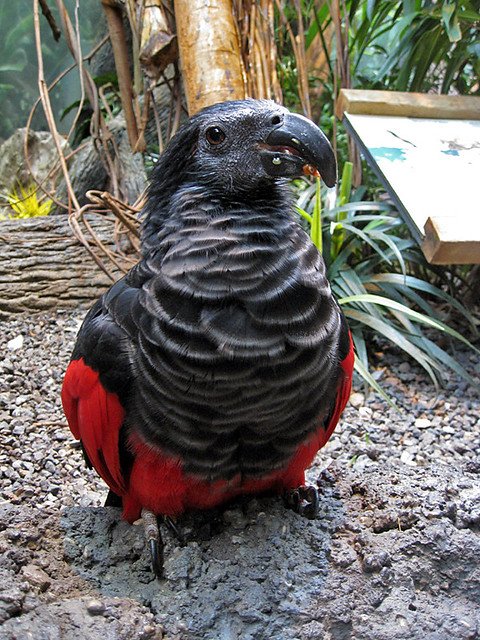
The bird most people call the “Dracula parrot” is actually Pesquet’s parrot (Psittrichas fulgidus). Its nickname comes from the striking contrast between its mostly black plumage and bold scarlet patches across its chest and wings, paired with its featherless, vulture-like face and long, hooked beak.
What sets this species apart from the other 390-plus parrot species is far more than its appearance. Unlike most parrots, Pesquet’s parrots have evolved a nearly exclusive fruit-based diet. They also move differently in the wild, preferring to hop between branches and use short, flapping glides rather than the climbing method many other parrots rely on.
Measuring close to 20 inches (about 46 centimeters) in length and weighing between 24 and 28 ounces (680 to 820 grams), they are roughly the size of a large cockatoo. Males can be distinguished from females by a small red patch of feathers just behind the eye, a detail that is absent in females.
Legality: Can You Own a Dracula Parrot in the US?
The short answer is no, not legally as a private pet. Based on what we see repeatedly in avian law discussions and official trade regulations, private ownership of Pesquet’s parrots is effectively prohibited in the United States.
| Jurisdiction | Legal Status for Private Ownership | Notes |
|---|---|---|
| United States | Not permitted for private buyers | Listed under CITES Appendix II. Import for commercial pet trade is highly restricted and virtually never granted to individuals. |
| Canada | Extremely restricted | Requires extensive permits and proof of conservation purpose; private pet ownership is not feasible. |
| European Union | Highly restricted | Subject to CITES and national laws; private ownership is rarely, if ever, authorized. |
| New Guinea (native range) | Protected by national law | Hunting and export are illegal without government permits. |
| Other countries | Varies widely | Most prohibit private trade due to conservation concerns. |
What this means in practice is that any online listing advertising a “Dracula parrot for sale” to U.S. buyers is either fraudulent, misrepresenting the bird, or offering an animal in violation of international and federal law. Pesquet’s parrots are also evaluated as Vulnerable on the International Union for Conservation of Nature (IUCN) Red List, a status that further restricts legal trade.
The Real Cost of a Dracula Parrot
Many listings we have seen online quote prices ranging from roughly $2,500 to $3,500 per bird. However, those figures reflect asking prices from unverified sources rather than legitimate market value for legally obtainable birds.
The reality is far different. There is no established, legal pet trade for Pesquet’s parrots. The birds that exist outside of New Guinea are almost exclusively found in accredited zoological institutions participating in carefully managed conservation breeding programs, not in private hands.
In our review of public forums and buyer inquiries, we repeatedly see would-be owners drawn in by these price tags only to discover later that the seller cannot legally ship the bird or, worse, that the listing is a scam. That disconnect between advertised price and actual legal availability is one of the most consistent patterns we have observed across bird enthusiast communities.
Diet and Feeding Challenges
One of the most overlooked realities of this species is its highly specialized diet. Pesquet’s parrots feed almost exclusively on specific species of figs in the wild. While they may occasionally consume other fruits, blossoms, or nectar, field observations consistently show figs make up the overwhelming majority of their intake.
This dietary specialization creates a challenge that goes well beyond typical parrot feeding. Maintaining a consistent supply of the correct fig varieties year-round is logistically difficult, expensive, and nearly impossible for most private households. Researchers have also noted that the bird’s featherless face is an adaptation that helps prevent its plumage from becoming matted by the sticky fig pulp, a clear indicator of just how dependent they are on this particular food source.
In our assessment, even experienced avian caretakers would struggle to replicate the nutritional profile and variety this species requires over the decades it can live.
Temperament, Vocalizations, and Daily Care
Very little peer-reviewed data exists on Pesquet’s parrots in private captivity simply because so few have been kept legally outside of zoological settings. What we do know comes largely from field observations and the limited accounts of accredited institutions.
In the wild, these birds tend to be relatively shy and reclusive, often staying high in the forest canopy. Their vocalizations are not the melodic whistles many people associate with pet parrots. Instead, they produce a harsh, raspy, and far-carrying call, often compared to the sound of heavy cloth being torn or the loud screeches of some cockatoos.
Beyond vocalization, their long-term care needs are substantial. Like many large parrots, they are highly social in the wild and would require extensive environmental enrichment, ample flight space, and consistent social interaction to avoid stress. Combined with their dietary demands, this makes them unsuitable for typical household environments.
Conservation: Why This Species Is at Risk
The push behind so many “for sale” searches has a direct consequence for wild populations. Pesquet’s parrots are considered vulnerable largely due to two pressures: habitat loss and poaching.
Deforestation across New Guinea’s lowland and montane rainforests continues to shrink the range of the specific fig trees this species depends on. At the same time, their striking plumage has long been prized for ceremonial headdresses in parts of their native range. Research surveying ceremonial attire found that a notable percentage contained Pesquet’s parrot feathers, underscoring the cultural demand that, when combined with commercial poaching, has driven population declines.
Conservation initiatives have focused on practical solutions, including distributing protective storage kits to help preserve existing headdresses and reduce the need to harvest new feathers. These efforts highlight a critical point: any unauthorized trade, whether real or attempted through online sales, directly undermines ongoing conservation work.
What We See From Real Buyers
A review of public discussions, such as the long-running Reddit thread we analyzed for this piece, shows a consistent pattern. Many prospective owners express genuine admiration for the bird’s appearance and ask earnestly whether ownership is fair to the animal.
What stands out most is how often those questions are met with informed pushback. Experienced commenters repeatedly point to the species’ vulnerable status, its highly specialized diet of figs, and the legal barriers involved. Others emphasize the long-term commitment required for any large parrot, noting that this species presents challenges well beyond the norm.
In nearly every case, those initial impulses shift toward a more conservation-minded view once the realities are understood. That pattern suggests most interest stems from fascination, not ill intent, but is fueled by misleading online listings.
Better Alternatives for Bird Lovers
For those drawn to the Dracula parrot’s striking looks or the appeal of a larger companion bird, there are several legally available species that offer a far more responsible path.
| Species | Legal Availability (Private) | Care Level | Notable Traits |
|---|---|---|---|
| Umbrella cockatoo (Cacatua alba) | Legally available from reputable breeders (with proper research) | High (long-lived, very social, needs significant enrichment) | Similar size profile, expressive personality, well-established in aviculture |
| Sulphur-crested cockatoo (Cacatua galerita) | Widely available from established breeders | High | Highly social, vocal, long-term commitment required |
| Red-shouldered macaw (Diopsittaca nobilis) | Commonly available | Moderate to high | Manageable size, playful, established pet trade |
| African grey parrot (Psittacus erithacus) | Available but subject to increasing regulation; requires careful breeder vetting | Very high (intellectual needs) | Renowned intelligence, strong bond potential |
The key difference is not just legality, but feasibility. These species have established captive breeding populations, well-documented care standards, and a far greater network of avian veterinarians familiar with their needs.
Frequently Asked Questions
Can I own a Dracula parrot in the US?
No. Pesquet’s parrots are protected under CITES Appendix II and are not legally available for private pet ownership in the United States. Any offer to sell one to a private buyer is almost certainly illegal or fraudulent.
How much do Dracula parrots cost?
Online listings often claim $2,500 to $3,500, but those prices reflect illegitimate offers rather than a legal market. There is no legal pet trade for private buyers, so a legitimate price simply does not exist for this purpose.
Can a Dracula parrot be a pet?
While biologically possible in theory under highly controlled conditions, it is not ethically or legally appropriate for private homes. Their specialized fig diet, complex welfare needs, and vulnerable status make private pet keeping unsuitable.
What is the lifespan of a Dracula parrot?
Precise data from captivity is limited, but based on similar large parrot species, it is reasonable to estimate a lifespan of 25 to 40 years or more in optimal conditions. That long-term commitment is another factor that makes private ownership impractical.
Is it fair to the bird to keep a Dracula parrot as a pet?
Given the species’ highly specific dietary and environmental needs, the legal restrictions, and the conservation pressures on wild populations, we do not believe private ownership is fair to the bird. The most responsible way to appreciate them is through accredited zoos, conservation programs, and reputable wildlife education resources.
Are the online “Dracula parrot for sale” listings real?
In the vast majority of cases, no. Our assessment of common listings shows many are scams designed to collect payments, while others misrepresent different bird species. Legitimate sources do not sell Pesquet’s parrots to private buyers.
Where can I see a Dracula parrot in person?
A limited number of accredited zoological institutions house Pesquet’s parrots, often as part of conservation and education programs. For example, institutions like the Toledo Zoo have featured this species in the past, though availability varies. We recommend contacting accredited zoos near you to inquire about current exhibits.
Reviews
There are no reviews yet.